GMAT Prep

Quick tips, in case you are preparing for GMAT. I scored 770 and got a lot of help from friends and forums. Here are things that helped me the most.
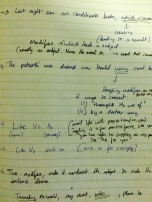
FullSizeRender 2Decide a study method – here is mine :

  1. Quick glance through materials – Write summary notes
  2. Repeat material studied within one week – Review notes and edit
  3. Problem solving from various sources – All errors noted, and lesson from error added into the summary.

So by the end of my study period I had review notes along with an error log. The photo of some sentence correction  notes may help. Whatever method you arrive at, please ensure you have summary notes and an error log. On the last day before the exam, going through it will give loads of confidence.

Study Material that helped –

  1. Quant – I used Kaplan’s GMAT premier. Also used GMATclub’s Math book – which was very very useful!
  2. Verbal – I used Manhattan’s books. The sentence correction book was a blessing.
  3. Official Guide – I solved the OG once, marked all my errors and solved the errors again. In certain cases I was wrong again on the second attempt, then I would repeat the process.
  4. On the phone – Gmat Toolkit app was my companion for over a month. I solved over 400 questions during this period just during my commute to work. Again, mistakes were reviewed a few times.

Study Timing & Preparing for war:

  1. 4 hour sessions on weekends –  A long Reading comprehension passage at the 3.5 hour mark is really hard because you just want the test to end. I think there is just one way to prepare for that – I maximised the numbers of 4 hour study sessions.Important also to not have water/food available (unless during the breaks).
  2. Making use of travel time – This was a big win. I practiced sentence correction on my way to work and quant on my way back. ( I enjoyed quant more and could motivate myself on the way back)
  3. Really tough problems by the pool side – I used to go sit by the pool side and try the really hard problems. It made the entire drill easier. Also, there was no wifi and phone connections there.
  4. Early morning sessions – If you are working then this is your saviour. My goal was to study half hour every morning. I failed sometimes, but sometimes the half hours became slightly longer. Half hours are a simple target and no matter how much you hate it-  just get that half hour done.
  5. Practice tests – I didn’t take up as many mock exams as my friends. The exams were useful initially to point out my worry areas and then I continued working at them. I used Manhattan initially – these are harder than the actual test so don’t lose heart. I completed the official test only towards the end of my prep to get a sense of the screen formats.

On the exam day: 

There is plenty of help out there about material you should carry and how you should prepare. Here are my tips, and each of these I tried on my mock exams as well.

  1. I carried an energy bar, water and headache pills(just in case). I had already tested this combo on my mock exams – so was good with them during breaks. More energy = more will power. The optional breaks are long enough. Of course, I had arranged my locker for quick access and already tested the bathroom – no surprises 🙂
  2. Timing & Scratch paper – It is important to stick to time on the GMAT. The scratch paper was my best friend to make this happen – I adopted a version of the tips mentioned here
  3. Keep calm and carry on!  – this was the biggest lesson! It is tempting to guess if the question is hard or easy. And when you do that, you get nervous if you are not certain of the answer.  if I wasn’t sure of the answer.  But the GMAT is pretty complex to guess your score. So it is important to accept that you could get answers wrong and still get a good score. So you just need to think of the question on the screen and carry on. When I found my mind wavering, I would rub my palms & eyes to reset my mind , then I would continue one. (my usual technique was to take a sip of water, but I learnt your can’t carry water into the exam)

Good luck!

Happy at work?

It doesn’t matter – the job, the salary, winning that argument. None of that matters at all – if you compared it to health, loved ones, happiness.

Why then get stressed? Why then get angry or frustrated?

Just keep going on. Remember why you are working; For happiness – you may derive it from solving a challenge or from the pay & recognition! But be happy!

If I ran my own school

The school will have 4 principle areas and each student will be measured on these 4 principles.

1) Self Sustenance –  Provide access to a balanced diet, hygienic shelter and sufficient clothing

2) Knowledge & Curiosity – Provide access to information about the world, sciences,arts,etc along with Understanding of interests, ability to express them and ability to pursue them

3) Interpersonal (and Intra-personal) skills –  Impart understanding of meta-knowledge (knowledge about knowledge), psychological structures and promoting reflection

4) Self Worth – Provide each student with opportunities to build self-esteem and understand their potential

All subjects,topics, sports will form perhaps verticals, but across them I will ensure that every student’s need across 4 pillars are met. (For example one student may build curiosity through learning about Tennis and another may build interpersonal skills by teaching Physics)

Dreaming out aloud 🙂

Over complicating!

I used to be a chronic “snooze-er”. Alarms will ring starting 5:30am and I ll wake up at 730!

For the last couple of weeks- I ‘ve not snoozed my alarm in the morning. I decide consciously about the time to wake up and I get out of bed. If I don’t get out of bed immediately, then there is a risk that I continue sleeping for long – well sometimes I like to live dangerously.

I was talking about the experience and my friend commented- “waking up without snoozing is easy right? Just get an alarm without a snooze button! ”

Why was I overcomplicating this?

I use the iPhone alarm and it’s easy to disable the snooze when you edit your alarm. I’ve disabled all the snooze functions!

Thanks Yong Kai!

Need to stop using jargon

I love complex ideas – because it’s rewarding when I understand them. Then I attach names to concepts- perhaps because am creative?

As a result, in discussions with others I start going on with my jargon and ideas. Yesterday in a meeting I explained how the current approach was flawed and that we needed a new one- I used terms like top down vs bottom up, metric based system . About 15 minutes later a question revealed that the listener didn’t understand my approach – I drew a basic flow chart and everything was clear. If only I started with the simple flow chart!

Need to find more ways to catch myself from complicating the trivial- extra complexity syndrome. Am doing it again… 🙂

Feedback …

Feedback & Criticism is awesome, but often hard to swallow. Yesterday, i had an interesting altercation which resulted in providing great insights.

It started as always with “you are wrong“, “No, you are wrong“. The switch happened when I admitted that I didn’t understand their point of view – “You know… I think I don’t understand, can you show me how you would do it better“. Slowly emotions dropped and we had a more logical discussion.

There are quite a few great feedback structures, but I think the key is to keep emotions out – well everything other than compassion perhaps.

When it’s going… Not so well!

When I am lost, when I am frustrated, when I am about to give up, when sleep doesn’t help…

I try to make it fun. If I am going down, I must as well have fun 🙂

Often i just need energy to turn the situation around, and when I have fun I often start finding pride in the work and that makes a huge difference to energy levels! Here is to finding more ways to have fun!

To be a Better Listener – Respond, don’t react…

From Inc – lovely article on listening

Respond, don’t react. I love this mantra and keep it top of mind, especially when I know I’m about to hear bad news or something that could upset me. It’s perfectly normal to want to spout out the first thing that hits your mind, but in most cases you’re better off to take a second to digest the content of what you’ve just heard.

“Listening is being able to be changed by the other person.”Alan Alda

Sometimes this means saying, “I heard you but I need time to think about my response”. That’s cool, as long as you don’t let too much time-lapse. Or, respond in the moment and then come back if after further thought you have additional comments to add. Both actions show the person 1) you heard them 2) you wanted to be thoughtful in your reply and 3) you take what was said seriously.